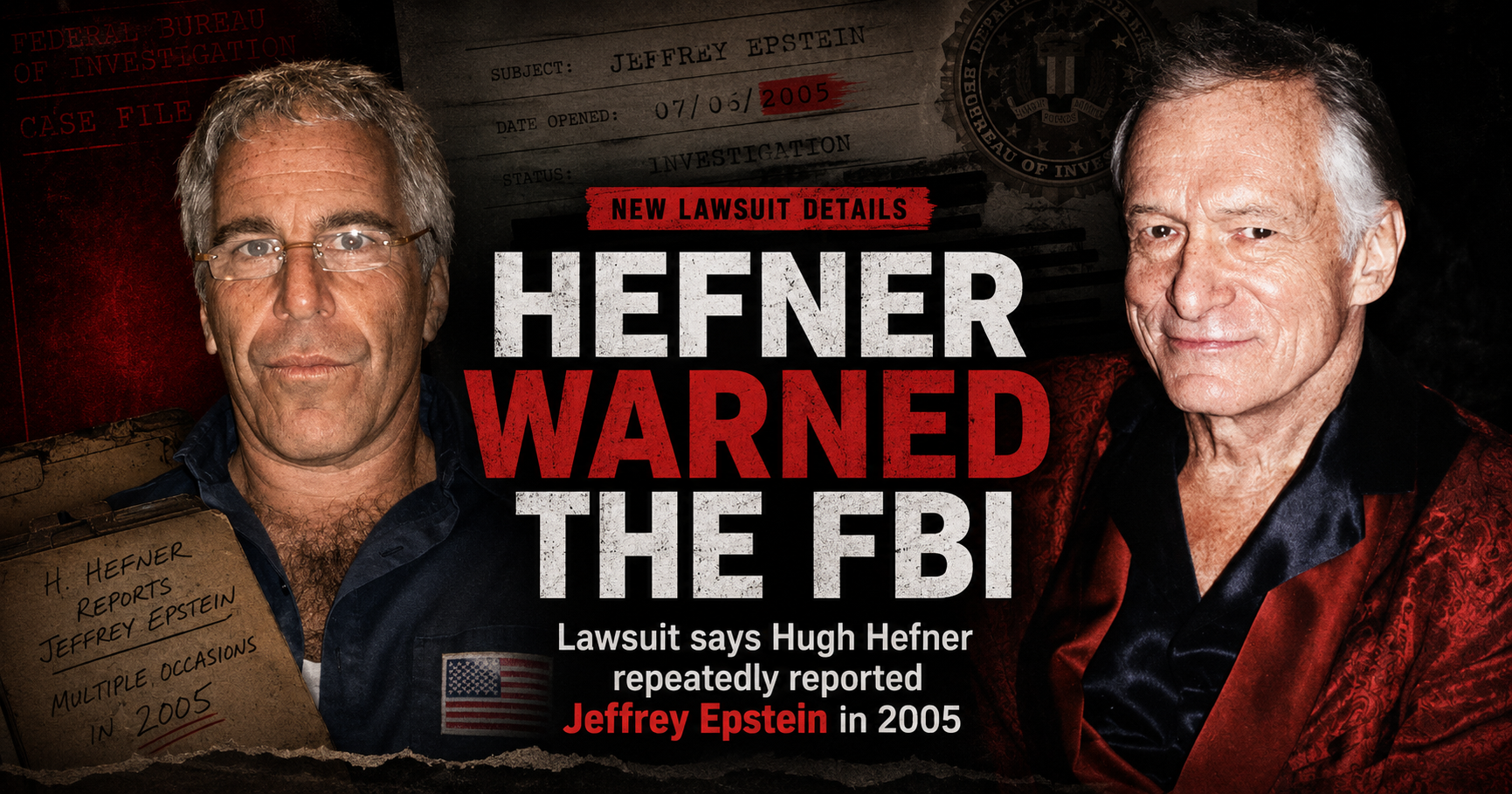
Hugh Hefner Warned the FBI About Jeffrey Epstein in 2005, Lawsuit Says — So Why Did a Playboy Playmate Wait 15 Years for a Follow-Up?
A newly amended lawsuit makes a stunning claim: Playboy founder Hugh Hefner repeatedly contacted the FBI in 2005 after Playmate Audra Lynn Christiansen told him Jeffrey Epstein had allegedly raped and trafficked her. According to the filing, federal agents did not follow up with Christiansen until 2020, 15 years later and after Epstein was already dead. Now 32 Epstein survivors are asking a federal court whether the government should be held accountable for warnings they say went unanswered.
 Marie NovakMarie Novak is a crime news writer for Crimehowl, covering true crime, missing persons cases, court updates, and stories that leave communities searching for answers. She focuses on writing with empathy, clarity, and a deep respect for victims and their families while encouraging readers to think critically about the cases that shape the headlines.
PUBLISHED AUG 21, 2026 · 06:30 | 14 MIN READ | LONG READ | FILED UNDER POLITICAL CRIME
**Content warning: This article discusses allegations of rape, sexual abuse and sex trafficking.
Of all the names anyone might expect to surface as someone who reportedly tried to warn federal investigators about Jeffrey Epstein, Hugh Hefner probably would not be near the top of the list.
But newly revealed allegations buried inside an ongoing federal lawsuit claim the late Playboy founder repeatedly contacted the FBI in 2005 after a young Playboy Playmate told him that Epstein had raped and trafficked her.
That woman was Audra Lynn Christiansen, Playboy’s Miss October 2003.
According to the lawsuit, Christiansen was 23 and living at the Playboy Mansion in Beverly Hills when she turned to Hefner for help. She allegedly believed the famous magazine publisher had enough connections and influence to make federal authorities listen to a young woman whose accusations might otherwise be dismissed.
The amended complaint says Hefner did exactly what she asked.
“Mr. Hefner called the FBI multiple times on behalf of Ms. Christiansen to report Jeffrey Epstein,” the filing states.
Then, according to Christiansen and the lawsuit brought by 32 Jeffrey Epstein survivors against the United States, something extraordinary happened.
She says she heard virtually nothing from the FBI for approximately 15 years.
Christiansen was reportedly not contacted by agents about the allegations until October 2020 — more than a year after Epstein died in federal custody and long after opportunities to question him about her account had disappeared.
The revelation has added another disturbing question to the already massive history of the Jeffrey Epstein FBI investigation:
If Hugh Hefner really called federal authorities multiple times in 2005 with an allegation involving rape and sex trafficking, what happened to those warnings?
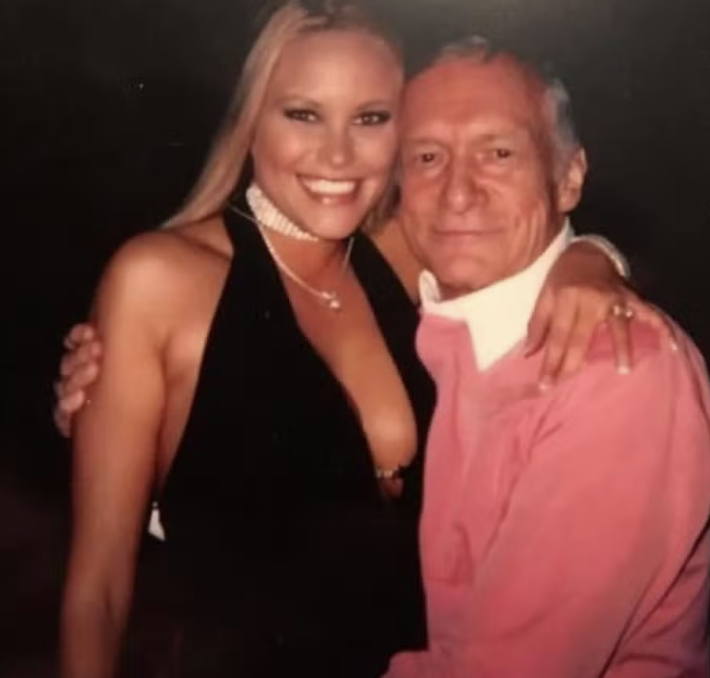
Audra Lynn Christiansen Says She Turned to Hugh Hefner for Help
Christiansen was building a modeling career when she became Playboy’s Miss October 2003.
According to the allegations described in the federal lawsuit, her agents later introduced her to Jeffrey Epstein after Epstein expressed interest in meeting her following the publication of her Playboy pictorial. That account appears in an FBI report documenting an interview with Christiansen years later.
What Christiansen says followed was horrifying.
The lawsuit alleges that Epstein raped her and trafficked her. Christiansen further alleged that she was trafficked to Stanley Ho, the powerful Macau casino billionaire who died in 2020. These remain Christiansen’s allegations as presented in the civil litigation; they have not been adjudicated in a criminal trial involving Ho.
By 2005, Christiansen says she was frightened enough to seek outside help.
But she did not initially place her faith in her own ability to convince federal law enforcement to investigate.
She reportedly believed Hefner could do something she could not.
He had fame.
Money.
Connections.
And, most importantly, what Christiansen viewed as “clout.”
So she asked the Playboy founder to contact the FBI for her.
According to the Audra Lynn Christiansen lawsuit allegations, Hefner called more than once.
That detail is particularly striking because 2005 would prove to be a pivotal year in the history of Jeffrey Epstein.
Another Epstein Investigation Was Already Beginning in Florida
The official Department of Justice timeline shows that the Palm Beach Police Department began investigating Epstein in 2005, after the parents of a 14-year-old girl reported that he had paid their daughter for a massage.
That local investigation uncovered additional girls who described being recruited to Epstein’s Palm Beach home for massages that frequently progressed into sexual activity.
In July 2006, a Palm Beach County grand jury indicted Epstein on a state prostitution-related charge.
But Palm Beach Police Chief Michael Reiter and the lead detective believed the state case failed to reflect the seriousness and scope of the evidence they had uncovered. They referred the matter to the FBI’s West Palm Beach office for a possible federal investigation.
Federal investigators eventually identified additional victims.
By May 2007, an assistant U.S. attorney had prepared a proposed 60-count federal indictment against Epstein, along with a lengthy prosecution memorandum detailing the evidence investigators had assembled.
Yet Epstein was never prosecuted on that proposed indictment.
Instead, his lawyers negotiated the now-infamous non-prosecution agreement with the U.S. Attorney’s Office for the Southern District of Florida.
Under that agreement, Epstein pleaded guilty to two Florida state offenses, while federal prosecutors agreed to end their investigation and forgo prosecution of Epstein, four named co-conspirators and any “potential co-conspirators.” Victims were not informed about the agreement before it was signed.
Epstein began an 18-month jail sentence in June 2008 but ultimately served less than 13 months and was permitted extensive work release.
That history was already controversial.
The alleged Hugh Hefner FBI warning about Jeffrey Epstein now raises the possibility that federal authorities possessed additional information about Epstein before their formal investigation even began.
The lawsuit is attempting to determine how much they knew and how early they knew it.

The FBI Allegedly Did Not Contact Christiansen Until 2020
According to the amended complaint, Christiansen did not receive the follow-up she expected after Hefner supposedly contacted federal authorities.
Fifteen years passed.
Epstein pleaded guilty in Florida.
He served his jail sentence.
He returned to his wealthy lifestyle.
The Miami Herald published Julie K. Brown’s landmark Perversion of Justice investigation in November 2018, bringing renewed national attention to Epstein’s victims and the controversial agreement that allowed him to avoid federal prosecution. The Justice Department itself later acknowledged that the 2007 non-prosecution agreement was a flawed mechanism and concluded that then-U.S. Attorney Alexander Acosta exercised “poor judgment” in resolving the case that way.
Federal prosecutors in New York eventually charged Epstein with sex trafficking of minors in July 2019. He died in federal custody the following month before the case went to trial.
Only afterward, according to the lawsuit, did the FBI finally contact Christiansen.
The call reportedly came in October 2020.
A document from that interview is now part of the evidence cited by the plaintiffs.
If the allegation about Hefner’s 2005 calls is proven accurate, that would mean the Playmate waited approximately 15 years between the original warning and the FBI’s follow-up.
By then, both Epstein and any possibility of prosecuting him personally were gone.
The Lawsuit Claims the FBI Received Warnings as Early as 1996
Christiansen is only one part of a much larger lawsuit.
The litigation involves 32 women who allege that the federal government negligently failed to protect them from Epstein despite the FBI receiving reports, tips and evidence concerning his sexual abuse and trafficking operation.
The case traces those alleged failures back even further than 2005.
The plaintiffs contend the FBI had information about Epstein as early as 1996. That portion of the case centers in part on artist Maria Farmer, who has long said she reported Epstein and Ghislaine Maxwell to federal authorities during the 1990s and warned that young girls were at risk. The current litigation argues that later victims could have been protected had authorities acted effectively on earlier warnings.
That is an allegation the plaintiffs still have to prove.
The case is not a criminal prosecution of FBI employees.
It is a negligence claim brought against the United States under the Federal Tort Claims Act, or FTCA.
The women essentially argue that federal agents violated mandatory policies governing the investigation of sex trafficking and child sexual abuse and that the government’s failures allowed Epstein’s abuse to continue.
The Government Has Been Fighting to Get the Case Dismissed
The legal battle itself is complicated.
The lawsuit was originally filed in Washington, D.C., in September 2024 before being transferred to the U.S. District Court for the Southern District of Florida in July 2025.
By September 2025, the 32 women were proceeding under a Third Amended Complaint.
The federal government asked the court to dismiss it on several grounds.
Among the government’s arguments were that the claims were filed too late, that federal law shields discretionary law-enforcement decisions from this type of lawsuit, that the plaintiffs had failed to establish a comparable duty under Florida law and that their allegations did not adequately establish that the FBI caused their later injuries.
In April 2026, U.S. District Judge David S. Leibowitz did dismiss that version of the complaint, but without prejudice, meaning the women were allowed another opportunity to amend their case.
The ruling was more complicated than a simple victory for the government.
The judge rejected the government’s attempt to knock out the claims on statute-of-limitations grounds at that early stage. He also concluded that the women had sufficiently alleged proximate causation to survive dismissal on that issue. And he disagreed that the discretionary-function defense necessarily justified throwing out the lawsuit before further factual development.
The fatal problem with that version of the lawsuit was jurisdictional.
The judge found that the women had not adequately alleged a Florida-law equivalent to the duty they claimed the FBI had undertaken.
But he gave them another chance.
A Fourth Amended Complaint was filed May 21, 2026, according to subsequent reporting on the case.
That is the filing containing the newly publicized details about Christiansen and Hefner.
Christiansen’s Account May Address a Critical Weakness in the Earlier Case
There is a reason the Hugh Hefner allegation could matter beyond producing an attention-grabbing headline.
Judge Leibowitz’s April ruling explained that one weakness in the Third Amended Complaint was the lack of sufficiently specific allegations showing that someone gave federal agents detailed information, received a representation that the FBI would act on it, and then relied on that promise rather than going elsewhere for help.
Christiansen had already submitted a sworn declaration in March 2026 as the plaintiffs attempted to strengthen that portion of the case.
The judge declined to add the late-filed affidavit to the record at that stage but specifically noted that Christiansen’s declaration existed and allowed the plaintiffs another opportunity to amend their pleading.
Her story now potentially gives the plaintiffs exactly the type of factual sequence the court said was missing:
A woman allegedly reports serious criminal conduct.
A powerful third party contacts the FBI on her behalf.
Federal authorities allegedly agree to assist.
The woman relies on that process.
Then, according to her account, meaningful follow-up does not occur for approximately 15 years.
Whether those allegations are enough to establish government liability is something the court still has to decide.

The FBI Says It Cannot Be Legally Required to Investigate Every Complaint
The government has continued trying to dismiss the amended case.
In its latest arguments, the FBI has taken the position that federal law does not impose liability simply because investigators fail to pursue every report received by the agency. Current reporting on the June 2026 dismissal effort quotes the government as arguing that the bureau is “not required to investigate every complaint.”
That argument reflects one of the central legal issues in the case.
Law-enforcement agencies routinely receive enormous numbers of tips. Agents must make judgment calls about credibility, available resources, jurisdiction and investigative priorities.
Federal law generally provides significant protection for those discretionary decisions.
The Epstein survivors are trying to establish that this was something different.
They argue that the FBI did not merely make a reasonable decision to prioritize one case over another. They claim agents ignored mandatory rules and failed repeatedly to act after receiving credible information about an ongoing sex-trafficking operation involving vulnerable girls and young women.
That distinction could determine whether their lawsuit survives.
The FBI Has Not Publicly Explained Hefner’s Alleged Calls
One of the largest unanswered questions is also the simplest.
Did the FBI document Hugh Hefner’s calls?
If so, where are those records?
Who received them?
What exactly did Hefner report?
Were the calls forwarded to another field office?
Was Christiansen’s name entered into an investigative file?
Did anyone compare Hefner’s information with the separate investigation unfolding in Palm Beach?
And if the FBI agreed to investigate, as the lawsuit alleges, why did Christiansen apparently not hear from agents until 2020?
The bureau has not publicly issued a detailed response specifically addressing the alleged 2005 Hugh Hefner Jeffrey Epstein tips.
Those answers could become extraordinarily important if the lawsuit reaches discovery and the plaintiffs are permitted to obtain internal FBI records.
Hugh Hefner’s Role Makes the Story Even More Complicated
There is an uncomfortable irony surrounding the revelation.
Hefner spent decades selling Playboy as a symbol of sexual freedom.
After his death in 2017, however, multiple women described a much darker environment around him and the Playboy Mansion.
The 2022 A&E documentary series Secrets of Playboy featured former girlfriends, employees and associates who made serious allegations of sexual misconduct, coercion, drug use, manipulation and abuse involving Hefner and others within the Playboy world. Hefner was dead by the time those claims became public in that form and therefore never faced criminal prosecution or a civil trial over the documentary’s allegations. Playboy’s current ownership publicly distanced itself from Hefner and expressed support for women who came forward.
Those accusations should not be treated as proven facts merely because they appeared in a documentary.
They also do not determine whether Hefner helped Christiansen in 2005.
Both things can exist in the same complicated history.
A man who has himself been accused posthumously of mistreating women could still have believed Christiansen and attempted to get authorities to help her.
If the lawsuit’s account is correct, that is exactly what happened.

Stanley Ho’s Name Adds Another Powerful Figure to the Allegations
Christiansen’s allegations also bring another famous billionaire into the story.
Stanley Ho built the casino empire that helped transform Macau into one of the world’s largest gambling centers. He was one of Asia’s most prominent businessmen before his death in 2020.
According to Christiansen’s allegations in the federal filing, Epstein trafficked her to Ho.
That accusation has not been established through a criminal conviction or civil judgment against Ho.
The newly released Epstein-related files have nevertheless demonstrated that Epstein knew of Ho and discussed him in private correspondence, according to current reporting.
For the plaintiffs, however, the significance is broader than one wealthy man.
Their lawsuit argues that Epstein’s social connections to powerful and wealthy people made meaningful law-enforcement intervention especially important.
They contend that failing to intervene allowed young women to remain vulnerable inside a network built around extraordinary wealth and access.
We Already Know the Government’s Handling of Epstein Was Deeply Controversial
Whatever happens with this new lawsuit, the federal government’s earlier handling of the Epstein investigation has already undergone extensive official scrutiny.
The Justice Department’s own Office of Professional Responsibility examined how the Southern District of Florida resolved its 2006-2008 investigation.
OPR did not conclude that former U.S. Attorney Alexander Acosta or the prosecutors involved committed professional misconduct.
But the review did conclude that Acosta exercised poor judgment in choosing the non-prosecution agreement and said the deal was a flawed way of resolving the federal interest in Epstein’s conduct.
The report also confirmed that federal prosecutors ended their investigation before significant investigative steps had been completed and agreed to unusual provisions while Epstein’s victims were kept unaware of the agreement.
Those findings are separate from Christiansen’s current lawsuit.
But they help explain why another allegation of an early warning allegedly going nowhere is receiving so much attention.
There is already a documented history of serious questions about how authorities handled Epstein.
The Most Disturbing Question Is Not Whether Hefner Made the Calls
The story naturally focuses on Hugh Hefner because his involvement is unexpected.
But the larger question has very little to do with Playboy.
Suppose the plaintiffs prove Hefner called.
Then what?
The important issue becomes what happened inside the FBI afterward.
Did a report get lost?
Did investigators dismiss Christiansen?
Did someone determine there was insufficient information to proceed?
Was her allegation entered into a system but never connected to the emerging Florida investigation?
Or did federal authorities receive enough information to justify further action and simply fail to act?
Those are dramatically different scenarios.
The civil case could potentially provide answers.

Could Acting Earlier Have Prevented More Abuse?
This is the question hanging over the entire Jeffrey Epstein FBI lawsuit.
Nobody can rewind history and determine with certainty what would have happened had an FBI investigation accelerated in 1996, 2005 or any other earlier point.
But by 2006 and 2007, federal agents had identified additional victims and prosecutors had developed enough evidence to draft a 60-count federal indictment.
Instead, Epstein entered the non-prosecution agreement.
He returned to society after serving less than 13 months.
More than a decade later, federal prosecutors in New York charged him again with sex trafficking minors.
The 32 plaintiffs now suing the United States say failures during those intervening years had devastating consequences.
The government argues that those claims face substantial legal barriers and that federal investigative decisions cannot simply be transformed into negligence lawsuits every time agents choose not to pursue a complaint.
A judge will have to decide where this case falls.
Fifteen Years Is a Long Time to Wait for Someone to Listen
The most powerful detail in Christiansen’s story may ultimately be the simplest.
She says she told someone.
She chose one of the most famous men in America because she believed his name might force authorities to pay attention.
According to her allegations, Hugh Hefner then called the FBI repeatedly.
And yet Christiansen says she did not hear from the bureau until 2020.
By then, Hefner was dead.
Stanley Ho was dead.
And Jeffrey Epstein was dead.
The opportunity to confront Epstein with her allegations was gone.
That does not automatically make the FBI legally liable for anything that happened afterward. The plaintiffs still have a difficult legal case to prove, and the government is actively fighting their claims.
But the lawsuit raises a question that goes beyond technical arguments about sovereign immunity and the Federal Tort Claims Act.
How many warnings should it take before the system is expected to act?
For Epstein’s survivors, that question is painfully familiar.
They have spent years learning that different people raised alarms at different times, only for the complete scale of what was happening to become undeniable much later.
Now they want a federal court to decide whether those alleged failures amount to more than mistakes.
They want to know whether they amount to negligence.
And the unexpected claim that Hugh Hefner may have been trying to get the FBI’s attention as early as 2005 could become one of the most astonishing pieces of that case.
What do you think? If the lawsuit proves Hugh Hefner repeatedly warned the FBI about Jeffrey Epstein in 2005, should the bureau be required to explain exactly what happened to those reports? And if federal investigators had acted more aggressively on earlier allegations, do you believe some of Epstein’s later victims could have been protected? Let us know what you think in the comments.