“That’s When I Realized I Had Been Gang-Raped”: Online Posts Triggered Cornell Student’s Reassessment of Fraternity Night Now Under Criminal Investigation
A former Cornell University student says she initially struggled to understand what happened after a night inside the Chi Phi fraternity house in October 2024. Days later, anonymous online posts discussing a sophomore being “gang raped” helped change how she viewed the encounter. Newly released police and Title IX records show that she later told investigators she was “100% confident” she had been raped. Now New York Attorney General Letitia James has taken over the criminal investigation after Gov. Kathy Hochul said serious questions remain about how the original case was handled.
 Marie NovakMarie Novak is a crime news writer for Crimehowl, covering true crime, missing persons cases, court updates, and stories that leave communities searching for answers. She focuses on writing with empathy, clarity, and a deep respect for victims and their families while encouraging readers to think critically about the cases that shape the headlines.
PUBLISHED OCT 02, 2026 · 21:38 | 17 MIN READ | LONG READ | FILED UNDER CURRENT CRIMES
Content warning: This article discusses allegations of rape, sexual assault, drug use and campus sexual violence. The allegations against the former fraternity members remain unproven, and no one has been convicted in connection with the alleged assault.
For days after leaving Cornell University’s Chi Phi fraternity house, the 20-year-old student now known publicly only as Jane Doe apparently struggled to put a name to what had happened.
She remembered arriving intoxicated.
She remembered beginning the night with sexual activity involving two men that she initially described as something she was “pretty OK with.”
She remembered ketamine.
She remembered more men entering the bedroom.
And she remembered eventually feeling overwhelmed, cornered and so impaired that, according to her later account, she no longer believed she was capable of making decisions for herself.
But in the immediate aftermath, Jane Doe did not initially describe the entire encounter as rape.
Then she started seeing what other students were saying online.
Anonymous posts on a Cornell Greek-life forum reportedly referenced Chi Phi members “gang banging” and accused fraternity members of drugging and raping a sophomore.
According to newly surfaced records from Cornell’s internal investigation, seeing strangers characterize what happened as an assault became a turning point for her.
About a week after the Oct. 19, 2024 encounter, she told investigators she began realizing that what she had experienced might not have been an embarrassing drunken sexual encounter at all.
“That’s kind of when I came to the realization that I had been gang raped,” she later said, according to Title IX records obtained by CBS News.
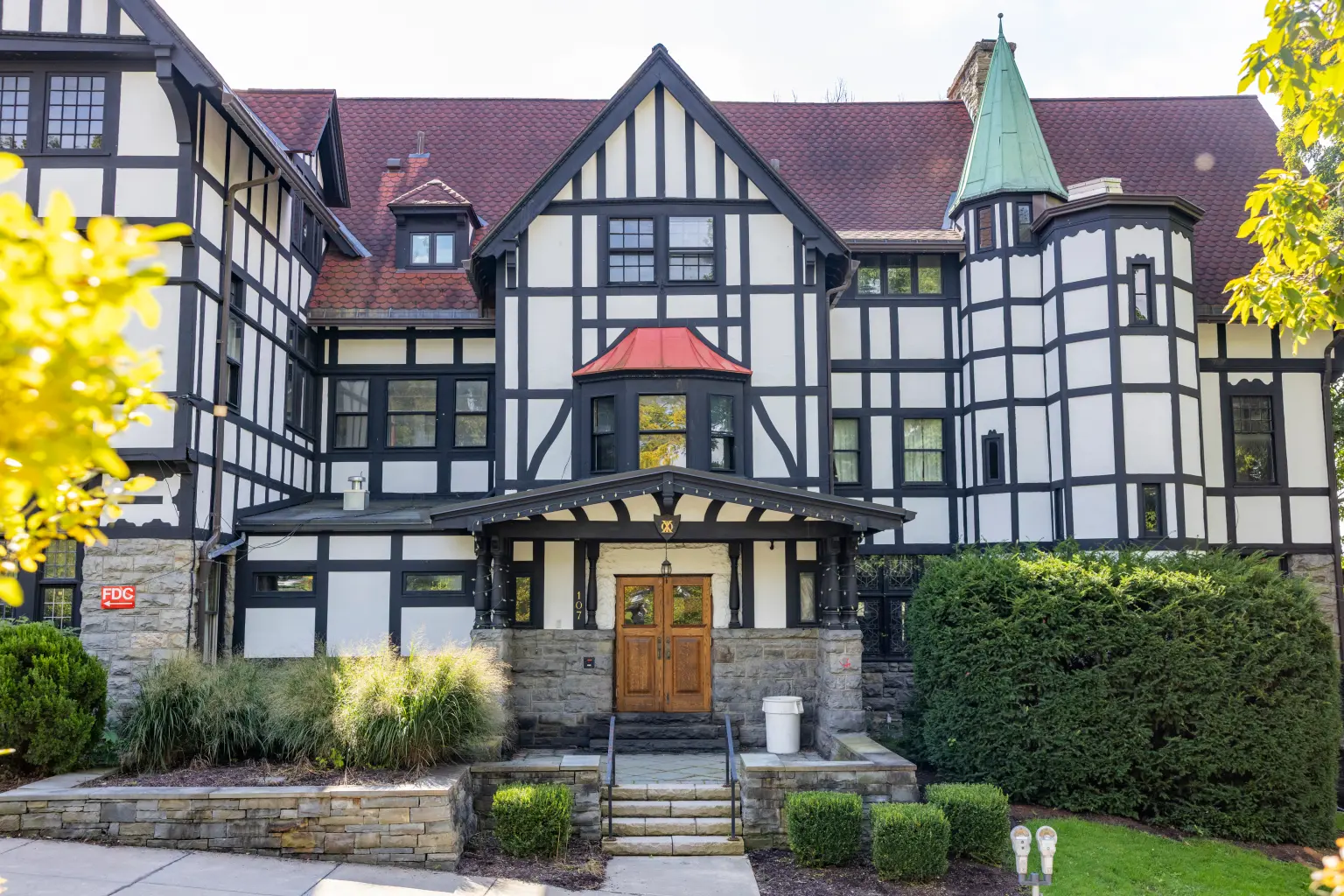
Almost two years later, that night at the Cornell Chi Phi fraternity house has become the center of a national controversy involving seven former fraternity members, Cornell University, campus police, a local district attorney and now the New York Attorney General’s Office.
A 101-page civil lawsuit filed in September accuses seven then-Chi Phi fraternity members of sexually assaulting Jane Doe over several hours after she became heavily intoxicated and used ketamine.
The defendants have not been criminally convicted. Attorneys representing some of the men have denied wrongdoing, and Cornell’s own disciplinary process reached different conclusions regarding different students.
But newly disclosed interview transcripts have raised serious questions about the original criminal investigation and about what information prosecutors actually received when they decided not to bring charges in 2024.
On Oct. 1, 2026, Gov. Kathy Hochul removed the case from Tompkins County District Attorney Matthew Van Houten and appointed Attorney General Letitia James as special prosecutor.
As of Oct. 2, James says the matter is now an active criminal investigation. KPRC

What Jane Doe Says Happened Inside the Chi Phi House
According to the civil lawsuit and investigative records, Jane Doe had already consumed a substantial amount of alcohol before arriving at the Chi Phi house at approximately 11 p.m. on Oct. 19, 2024.
Earlier in the evening, she had been drinking vodka at her sorority house before going to bars in Ithaca. She later went alone to Chi Phi to meet a fraternity member she knew.
Jane Doe has consistently distinguished the beginning of the night from what she alleges happened later.
During her Nov. 14, 2024 interview with Cornell police and Title IX personnel, she said she initially participated in sexual activity with two men she knew and was “pretty OK” with it, while also emphasizing that she was already extremely drunk.
The lawsuit alleges that the situation then changed dramatically.
She says she was encouraged or pressured to take ketamine and became increasingly impaired as additional fraternity members entered the upstairs bedroom.
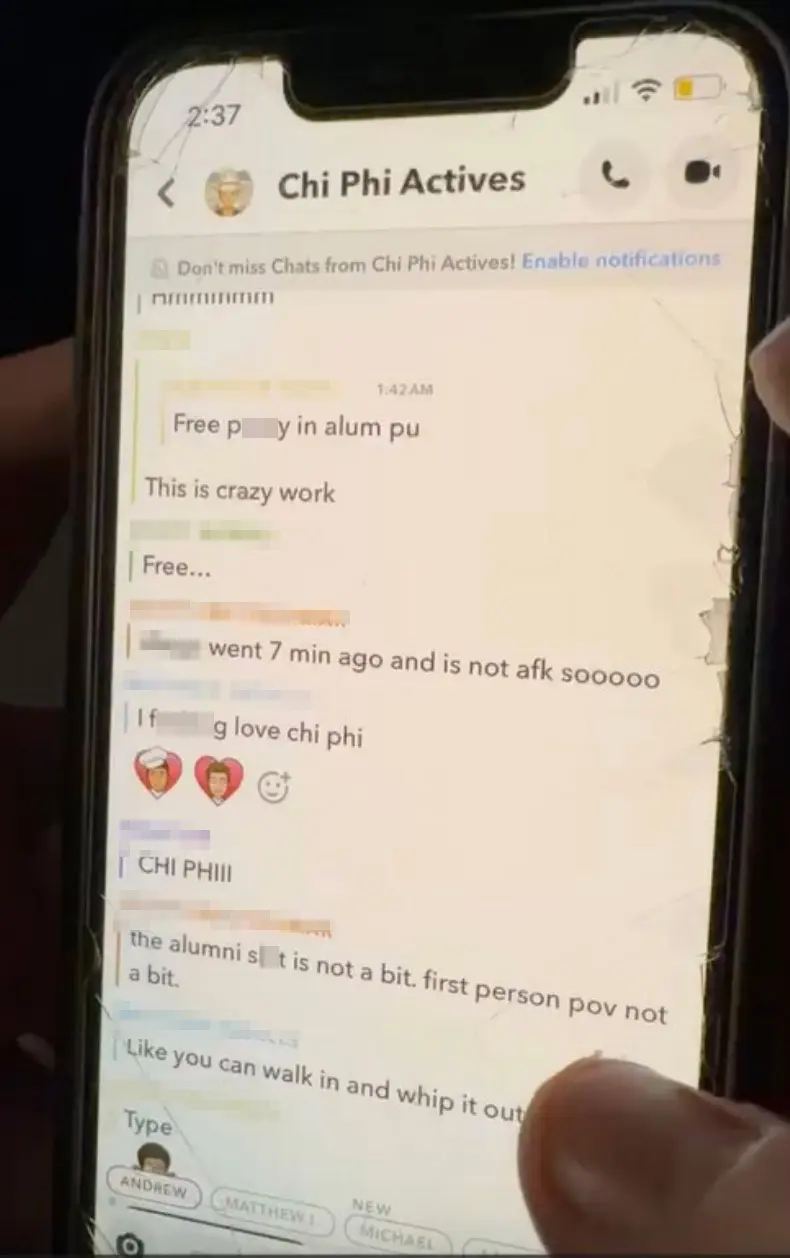
At approximately 1:42 a.m., one fraternity member allegedly posted a crude message in the fraternity’s “Chi Phi Actives” Snapchat group suggesting that a woman upstairs was available for sex.
A later message asked whether the “shop” was still open.
The response was yes.
Jane Doe alleges that additional men subsequently entered the bedroom and that sexual acts continued for hours.
In one later disciplinary hearing, she described herself as feeling like “bait” surrounded by “lions.” The Washington Post
According to the civil complaint, the alleged assaults continued until approximately 5:45 a.m., when she lost consciousness.
Those claims remain allegations that will need to be tested through the criminal and civil legal processes.
She Initially Tried to Make Sense of the Night as Consensual
What happened afterward has become nearly as important as the allegations about the night itself.
When Jane Doe returned to her residence, she discussed the experience with roommates.
One roommate recalled her laughing while describing the events as something “crazy” she had done but believed she appeared to be in shock.
Another roommate remembered Doe saying she had been uncomfortable.
Friends later told Cornell investigators that they believed she had not fully processed what had happened.
One roommate said she thought Jane Doe wanted the encounter to have been consensual and would sometimes describe a part of the night only for friends to tell her that what she was describing sounded like sexual assault.
Her sorority mentor similarly recalled believing that Doe was in shock and had not yet understood the gravity of what she had experienced.
That gradual change in how she described the night is now central to the case.
Defense attorneys could point to early statements suggesting consensual activity.
Jane Doe’s attorneys argue that those early statements reflected trauma, confusion, intoxication and her attempt to understand an experience she had not yet processed.
The newly released records show that both things existed within days of each other.
Her Early Text Messages Will Almost Certainly Become Important Evidence
Messages exchanged shortly after the alleged assault complicate the timeline further.
Two days after the encounter, one of the men reportedly apologized to Jane Doe for how the night “went down,” saying his memory was fuzzy and that he and another man regretted being too intoxicated to stop things before they got out of hand.
Doe replied that her memory was also extremely clouded and wrote that none of the sexual activity had been “illegal.”
She also said she had enjoyed being with two of the men, while joking that if they spent time together again they should leave out the additional men and ketamine.
Those texts are likely to be highlighted heavily by attorneys representing the accused.
But other messages from that same period reveal distress.
On Oct. 23, Jane Doe reportedly told one of the men that the situation was temporarily “ruining” her life and that she was spending her days sleeping and crying.
By Nov. 3, her description had changed substantially.
According to the internal investigation, she told fraternity members that 90% of what happened that night was not consensual and said she felt like a “sex doll.”
The question for investigators will not simply be which message existed.
It will be how all of them fit together.
Anonymous Online Posts Became a Turning Point
One of the newest and strangest, details in the Cornell fraternity rape investigation is the apparent role played by anonymous online posts.
About a week after the alleged incident, Jane Doe reportedly encountered posts on a Greek-life discussion forum accusing Chi Phi members of sexually assaulting a sophomore.
According to records described by CBS News, one post referred to fraternity brothers “gang banging,” while another accused members of using drugs and gang-raping a student.
Jane Doe told Cornell investigators that seeing other people describe what had happened in those terms changed something for her.
For the first time, she said, the narrative was no longer simply that she had behaved promiscuously.
It was that she may have been assaulted.
“That’s kind of when I came to the realization that I had been gang raped,” she later explained.
That realization reportedly occurred around the same time one roommate overheard Doe confronting one of the men about having penetrative sex with her when she was so impaired by ketamine that her eyes were crossed.
A Medical Visit Three Days Later Is Now Under Scrutiny
Three days after the fraternity encounter, Jane Doe went to Cornell Health.
Her attorney says she sought treatment for a urinary tract infection and underwent testing for sexually transmitted infections.
According to attorney Thomas Giuffra, Jane Doe told the medical provider that she believed she had contracted the UTI in a “traumatic way.”
The attorney says she was advised to speak with someone but was not immediately referred for a sexual-assault forensic examination.
She eventually requested a rape kit on Nov. 7.
By then, more than two weeks had passed.
Giuffra says the delay meant there was no longer recoverable DNA evidence from the night in question.
Whether Cornell Health personnel should have handled the Oct. 22 appointment differently is now one of several issues surrounding the university’s response.
Jane Doe Reported the Case to Police on Nov. 8, 2024
One timeline detail is important to correct because it has been misstated in some retellings of the case.
Jane Doe did not wait until November 2025 to report the allegations.
Records show she reported the incident to the Cornell University Police Department on Nov. 8, 2024, approximately three weeks after the night at Chi Phi.
Cornell suspended the Chi Phi chapter that day and temporarily suspended the seven students who would later be named in the civil lawsuit while the university began its investigation.
On Nov. 14 and Nov. 15, Jane Doe participated in a lengthy interview involving a Cornell police investigator, Title IX personnel, a victim advocate and an adviser.
That interview transcript has now become one of the most controversial pieces of evidence in the entire case.
“I Can Say With 100% Confidence I Was Raped”
The transcript obtained by CBS News shows that Jane Doe did not simply describe the night as consensual.
She differentiated between the initial encounter and what happened later.
When discussing the beginning, she acknowledged being “pretty OK” with the initial sexual activity despite her intoxication.
But later in the interview, she was unequivocal.
“I can say with 100% confidence I was raped,” she told investigators.
She also described herself as “completely and totally incapacitated,” said she felt coerced and told investigators she became too intoxicated to make decisions.
Jane Doe further alleged that she was physically struck during parts of the encounter.
Investigators prepared a six-page sworn statement based on the interview.
The transcript shows that the investigator read the account back to Doe and allowed her to make changes before she signed it.
She reportedly told them she was “very confident” in the final statement.
That makes what happened next especially controversial.
The District Attorney Says He Never Saw the Full Interview Transcript
Tompkins County District Attorney Matthew Van Houten decided in 2024 not to bring criminal charges against the fraternity members.
When the case exploded back into public view in September 2026, Van Houten defended that original decision.
He said the sworn statement his office received did not allege that Jane Doe had been drugged against her will or gang-raped and instead described her participation in drugs and sexual activity as voluntary and consensual.
But CBS News then showed Van Houten portions of the longer interview transcript.
The district attorney said he had never seen it.
He specifically said he had not previously heard Jane Doe’s statement that she was “100% confident” she had been raped.
Cornell says campus police provided Van Houten’s office with Jane Doe’s six-page sworn statement and the screenshot of the fraternity Snapchat conversation.
The university has not said that the entire interview transcript was provided to prosecutors at the time.
That gap is now one of the central questions facing the new investigation.
How did an interview in which a student expressly said she had been raped become a written record the local prosecutor says did not convey that allegation in the same way?
Van Houten Reopened the Criminal Investigation
After the September lawsuit generated national attention and additional records became public, Van Houten announced on Sept. 28 that his office would reopen the criminal case.
Before being removed from the matter, he said he hoped to present evidence to a grand jury within approximately 45 days.
He maintained that prosecutors could only make their 2024 decision based on the material available at the time and said the new civil complaint contained allegations that were dramatically different from what his office originally received.
Van Houten also characterized the fraternity Snapchat discussion as vulgar and disturbing but argued that the messages themselves did not resolve the legal issue of whether individual sexual acts were consensual.
Jane Doe’s attorney fiercely criticized that response, saying his client had reported rape to campus police and that prosecutors never personally interviewed her before closing the case.
Gov. Kathy Hochul Took the Case Away From the Local DA
The reopening did not end the controversy.
On Oct. 1, New York Gov. Kathy Hochul signed an executive order appointing Attorney General Letitia James as special prosecutor and removing Van Houten’s office from control of the investigation.
Hochul said newly released information had undermined her confidence in how the case had been investigated and in the local district attorney’s ability to continue overseeing it.
Speaking publicly on Oct. 2, Hochul criticized the fact that the district attorney had not personally interviewed Jane Doe or the accused men before the initial case was closed.
James said her office would review records, gather evidence, interview witnesses and pursue prosecution if investigators determine charges are warranted.
“This is now an active criminal investigation,” James said.
That does not mean charges are inevitable.
The attorney general’s office must now conduct the investigation that state officials say should have occurred more thoroughly the first time.
Cornell Says Its Internal Investigation Was Extensive
Cornell has rejected claims that it simply ignored the accusations.
The university conducted a lengthy Title IX process involving dozens of witness interviews and months of investigation.
Court records describe more than 50 interviews involving 32 witnesses, followed by a multi-day disciplinary hearing.
Cornell says the seven accused students did not all receive the same outcome because the evidence against them was different.
Two were expelled.
Two were suspended for at least two semesters.
One had already graduated before discipline could be imposed.
Two were found not responsible for sexual misconduct.
The university also shut down the Chi Phi chapter in 2024, and the fraternity remains barred from campus.
Cornell has disputed online claims that several fraternity members escaped punishment by merely writing essays.
The university says no student received essay-writing as the sole consequence of involvement in the case.
Cornell has since agreed to bring in outside counsel for an independent review and says it supports transferring the criminal investigation to James.
Some Accused Fraternity Members Deny Sexual Assault
It is equally important to include what attorneys for accused students are saying.
At least two defendants have publicly denied committing sexual assault.
Attorney Jeremy Saland, representing one former fraternity member, acknowledged that the Snapchat conversation was inappropriate but said participation in an offensive chat does not prove rape.
He says his client went into the room briefly, did not touch Jane Doe and left within minutes.
Cornell’s own disciplinary panel reportedly did not find that student responsible for sexually assaulting Doe.
Another attorney, Andrew Miltenberg, has warned that public outrage and sympathy for an accuser cannot replace due process.
One accused former student has reportedly been publicly confronted, and lawyers say family members and attorneys have received threats as the case has exploded online.
No one charged in the civil lawsuit should be described as criminally guilty unless and until that is established in court.
One Student Is Fighting Cornell’s Disciplinary Finding
Recently unsealed court records also reveal how complicated Cornell’s disciplinary proceedings became.
One student acknowledged entering the room after seeing the Snapchat message but reportedly said he believed it was a joke and also claimed he went upstairs partly because he thought something might be wrong.
Cornell’s panel did not find sufficient evidence that he sexually assaulted Jane Doe or used ketamine from her body.
It instead found him responsible for attempted sexual exploitation because he saw the message and entered the room.
He challenged that finding in court, arguing that he had not originally been charged with attempted sexual exploitation.
A judge rejected his challenge, and he is appealing.
That case illustrates why the phrase “seven men accused of rape” can obscure important differences in the specific allegations and evidence involving each individual defendant.
New York’s Rape Law Has Become Part of the Story
The Cornell alleged gang rape case is now creating a debate far beyond Ithaca.
New York law has long been criticized for how it handles cases in which an alleged victim becomes severely impaired after voluntarily consuming alcohol or drugs.
Under current law, someone can be legally incapable of consenting if they are unconscious or otherwise physically helpless.
A person may also be legally “mentally incapacitated” when an intoxicating substance was administered without that person's consent.
That leaves a more difficult path when someone voluntarily drinks alcohol or takes a drug but later becomes so intoxicated that their ability to make decisions is severely compromised.
The issue has become directly intertwined with the Cornell case because Jane Doe acknowledges voluntarily drinking alcohol and consuming some drugs but alleges she was pressured to take ketamine and ultimately became incapacitated.
Van Houten cited New York’s existing legal framework when explaining why he initially concluded the available evidence would not support prosecution.
Hochul Now Wants the Law Changed
On Oct. 2, Hochul announced that she plans to work with state lawmakers to change what critics call New York’s “voluntary intoxication loophole.”
Legislation addressing the issue has repeatedly passed the state Senate but stalled in the Assembly.
The proposed change would make clear that extreme incapacitation can undermine a person’s ability to consent even when the person voluntarily consumed the alcohol or drugs that caused the impairment.
That debate will continue independently of whether prosecutors ultimately charge anyone in the Cornell case.
Changing the statute in the future would not automatically rewrite the criminal law that applied on Oct. 19, 2024.
The Civil Lawsuit Brought Everything Back Into Public View
Jane Doe filed her civil lawsuit on Sept. 16, 2026, naming Cornell University, Chi Phi-related entities and seven former fraternity members.
The lawsuit accuses the university and others of negligence and violations of state law and seeks compensatory and punitive damages.
No specific dollar amount is listed.
Her attorney says she eventually left Cornell because of the trauma associated with the incident.
The lawsuit was the catalyst for renewed public attention, the reopening of the criminal investigation and ultimately Hochul’s decision to install a special prosecutor.
What had been a closed criminal matter for nearly two years is now being examined all over again.
The Online Posts That Changed Everything
Among all the newly released evidence, the anonymous posts Jane Doe saw after the alleged assault may be some of the most psychologically revealing.
She had spent days attempting to interpret the night as something she participated in.
Her roommates remembered her appearing shocked and confused.
Her early messages included statements that could be read as minimizing what happened.
Then she saw outsiders talking about a sophomore allegedly being gang-raped at Chi Phi.
Suddenly, in her telling, she saw her own experience differently.
That does not prove the criminal allegations.
It also does not prove her later interpretation was wrong.
It shows how dramatically a person's understanding of a traumatic or confusing event can evolve after the immediate aftermath.
That evolution is now something investigators, prosecutors and potentially jurors will have to examine carefully.
The Biggest Question Now Is What the New Investigation Finds
There are two dangers in a case like this.
One is assuming that because Jane Doe initially used language suggesting some sexual activity was consensual, nothing criminal could possibly have happened later.
The other is assuming that because the allegations are horrifying and have generated massive public outrage, every person named in the lawsuit must be guilty.
The evidence has to answer those questions.
James’ investigators now have access to information that apparently was not fully examined during the original criminal review: the complete interview transcripts, extensive Title IX records, Snapchat messages, witness accounts, disciplinary findings and whatever additional electronic evidence may still exist.
They will also have the ability to interview Jane Doe and the accused men directly.
As of Oct. 2, 2026, no criminal charges have been filed against the seven former Chi Phi members in connection with Jane Doe’s allegations.
The investigation is active, and the outcome remains unknown.
But this time, the allegations are not disappearing quietly.
Nearly Two Years Later, the Case Is Starting Over
What allegedly happened inside the Chi Phi house lasted a matter of hours.
The argument over what those hours meant has lasted almost two years.
Jane Doe initially tried to understand the night.
Her friends urged her to examine it differently.
Anonymous posts made her question the story she was telling herself.
She sought medical treatment.
She obtained a rape kit.
She went to police.
She participated in hours of interviews.
Cornell conducted a major disciplinary investigation.
A local prosecutor declined criminal charges.
Then a lawsuit exposed records the public had never seen.
Now New York’s attorney general is essentially beginning a new criminal investigation from the evidence up.
Whatever James’ office ultimately concludes, the Cornell University Chi Phi sexual assault case has already exposed difficult questions about campus investigations, intoxication, consent, trauma, fraternity culture and what happens when universities and criminal prosecutors operate with different pieces of the same story.
Jane Doe told investigators in 2024 that she was certain she had been raped.
The public did not hear those words until 2026.
The question now is whether investigators can determine what happened inside that bedroom and whether New York law provides a criminal path forward if they do.
What part of this case raises the biggest question for you: the Snapchat messages, the difference between Jane Doe’s early texts and later statements, the delayed rape kit, or the fact that the district attorney says he never received the full interview transcript where she explicitly said she had been raped? And do you think New York should change its law so someone who becomes severely incapacitated after voluntarily drinking or taking drugs can still be legally incapable of consent? Share your thoughts in the comments.