“It’s a Scam”: Lauren Boebert Blasts Explosive Claims She Had Sex With 3 Staffers—But the Ethics Filing Faces a Major Procedural Problem
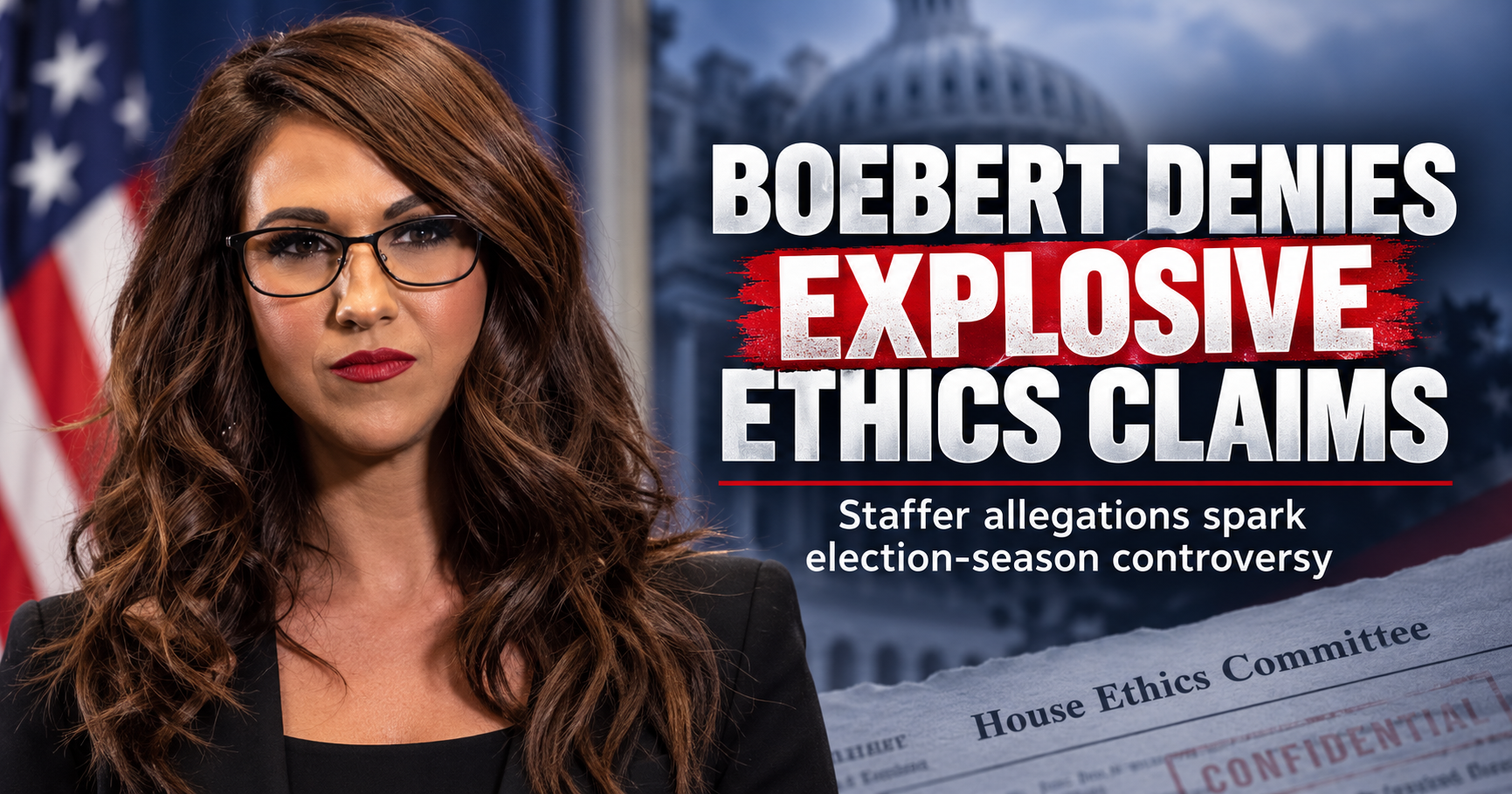
Rep. Lauren Boebert is forcefully denying a sworn filing that accuses her of sexual relationships with three congressional staffers and an alleged $200,000 payment involving a former aide. But the controversy has an unusual twist: House Ethics rules appear to prevent the filing from being accepted as a formal complaint this close to Election Day. That does not necessarily stop the committee from examining the underlying information on its own.
 Marie NovakMarie Novak is a crime news writer for Crimehowl, covering true crime, missing persons cases, court updates, and stories that leave communities searching for answers. She focuses on writing with empathy, clarity, and a deep respect for victims and their families while encouraging readers to think critically about the cases that shape the headlines.
PUBLISHED SEP 21, 2026 · 18:20 | 12 MIN READ | LONG READ | FILED UNDER POLITICAL CRIME
Content note: This article discusses allegations of sexual relationships and congressional misconduct. None of the allegations described below have been substantiated by the House Ethics Committee or proven in court.
Rep. Lauren Boebert is fighting back against one of the most salacious allegations of her congressional career.
A sworn filing submitted to the House Committee on Ethics on September 17 alleges that the Colorado Republican engaged in sexual relationships with three current or former members of her congressional staff, two women and one man, and arranged an approximately $200,000 payment connected to one former aide.
Boebert says none of it happened.
“I have never had a sexual relationship or an inappropriate romantic relationship with any member of my staff, past or present,” the congresswoman said in a statement released by her office, calling the allegations “utterly false” and describing the filing as politically motivated.
The accusations were submitted by David B. Wheeler, who leads the political group American Muckrakers and has spent years targeting Boebert with allegations, some of which previously contained significant errors.
The filing names former District Director Clarice Navarro Ratzlaff, current District Chief of Staff Raven Finegan, and former Chief of Staff Jeffrey Small as the employees with whom Wheeler alleges Boebert had relationships. It also contains financial allegations involving campaign and government money.
But before anyone assumes Boebert is now the subject of a formal House Ethics investigation, there is an important distinction.
As of September 21, the House Ethics Committee has not publicly announced an investigation into Boebert over these allegations. And the committee's own rules create two procedural obstacles for Wheeler's submission.
That makes this story significantly more complicated than the headline-grabbing allegations suggest.

What Does the Lauren Boebert Ethics Filing Actually Allege?
Wheeler submitted his document on September 17 under oath.
The most detailed portion concerns Clarice Navarro Ratzlaff, who served as Boebert's district director from 2021 until early 2025.
The filing alleges that Boebert and Navarro had a sexual relationship while Navarro worked under the congresswoman's supervision.
It further alleges that some encounters occurred in locations connected to congressional or campaign activity and claims that payments and reimbursements made to Navarro should be investigated.
The most explosive financial accusation is that approximately $200,000 was allegedly paid to Navarro in 2025 after she supposedly threatened to file an ethics complaint of her own. Wheeler characterizes that money as essentially a payment intended to keep her silent.
Boebert denies that allegation along with the sexual-relationship claims.
And Navarro herself has issued an unequivocal denial.
“These allegations regarding me are entirely false, defamatory, and beyond ridiculous,” she told the Colorado Times Recorder. “There is absolutely no truth to any part of this claim.”
The filing makes additional allegations involving Finegan and Small, claiming sexual relationships existed while they were members of Boebert's staff.
The New York Post reported that the staffers named in the allegations denied the claims.
None of these alleged relationships has been established by an Ethics Committee finding, civil judgment or criminal proceeding.
House Rules Really Do Prohibit Sex With Staff You Supervise
One part of the controversy is straightforward.
If the alleged relationships occurred as Wheeler describes them, they could implicate an explicit House rule.
House Rule 23 states that a member of Congress “may not engage in a sexual relationship with any employee of the House who works under the supervision” of that member. The prohibition also covers employees of committees on which the member serves. Married couples are exempt.
The rule was adopted during the congressional reforms that followed the #MeToo reckoning and applies regardless of whether the alleged relationship was consensual.
That is an important distinction.
This filing is not primarily accusing Boebert of sexual assault. Rather, its central allegation is that she had consensual sexual relationships with employees she supervised, which could itself constitute an ethics violation if established.
But having a rule and proving that someone violated it are very different things.
So far, the public record contains allegations, denials and a filing whose procedural status is disputed.
Boebert Says the Filing Isn't Even a Valid Ethics Complaint
Boebert's strongest immediate defense is not about sex.
It is about procedure.
The congresswoman pointed to House Ethics Committee Rule 15, which says the committee shall not accept, and must return, a complaint submitted during the 60 days before an election in which the accused member is a candidate.
Boebert is running for reelection in Colorado's 4th Congressional District on November 3, 2026. The Federal Election Commission lists her as the Republican incumbent candidate for that race.
Wheeler submitted his filing September 17.
That puts it well inside the 60-day window.
The second problem involves who filed it.
Committee procedures state that information submitted as a complaint by someone who is not a member of the House requires written certification from a House member saying the information was submitted in good faith and warrants committee consideration.
Wheeler is not a member of Congress.
Boebert's office says no House member has provided the required certification.
On that narrow procedural point, the published House Ethics rules support the distinction Boebert is making: Wheeler's September 17 submission does not appear able to move forward as an ordinary formal complaint during this election-period window.

But That Doesn't Necessarily Make the Allegations Disappear
There is another provision Boebert's response does not eliminate.
The Ethics Committee has authority to act on its own initiative.
Official committee procedures say that even in the absence of a properly filed complaint, the panel may consider information already in its possession indicating that a member may have violated House rules, laws or other standards of conduct.
In other words, two things can simultaneously be true.
Wheeler's document may not qualify as a formal complaint because of the election timing and lack of member certification.
But if Ethics Committee members independently decide information contained in the filing warrants examination, the committee has separate authority to initiate an inquiry.
There is no public indication as of September 21 that it has done so.
That nuance matters because some coverage has loosely described Boebert as facing an Ethics Committee investigation when, at this point, the confirmed development is that an outside activist submitted allegations to the committee.
Who Is David Wheeler?
The credibility of the person behind the allegations has become a major part of Boebert's defense.
David Wheeler leads American Muckrakers, a political organization that previously focused extensively on Boebert.
His history with her goes back years.
In 2022, American Muckrakers publicly accused Boebert of previously working as a paid escort and made additional claims about her personal history.
Independent fact-checkers found serious problems with the evidence presented.
Lead Stories concluded that the group had not provided evidence sufficient to establish the escort claim and noted that at least one photograph circulated as purported evidence did not depict Boebert at all.
Wheeler later acknowledged errors in that earlier effort, describing aspects of the research as sloppy, while maintaining some of his broader accusations.
That history does not automatically establish that his newest allegations are false.
A source can be wrong about one story and right about another.
But it does mean Wheeler's newest accusations require independent corroboration rather than being treated as established simply because he signed his filing under penalty of perjury.
Boebert has emphasized exactly that point.
Does Signing Something “Under Penalty of Perjury” Make It True?
No.
This has become another source of confusion surrounding the Lauren Boebert ethics complaint.
Wheeler signed the filing under oath, and supporters of the allegations have emphasized that he theoretically exposes himself to legal consequences by intentionally making material false statements in circumstances covered by perjury laws.
That increases the seriousness of the filing.
It does not prove its contents.
People submit sworn statements in lawsuits, depositions and criminal proceedings every day. Courts and investigators still require corroboration, records, witness testimony and other evidence before deciding whose version of events is credible.
Wheeler says his accusations are backed by sources and information including purported text messages, financial records, court documents and recorded conversations.
Much of that underlying material has not been independently authenticated in the public reporting reviewed for this article.

The Public Evidence Released So Far Is Limited
The complaint includes photographs and references to payments and travel records.
But those materials do not independently establish a sexual relationship.
The Colorado Times Recorder, which first reported extensively on the filing, noted that two of its own older articles cited inside Wheeler's complaint simply showed Navarro accompanying Boebert or performing her normal duties as district director. Neither article alleged an affair at the time.
LGBTQ Nation similarly reviewed photographs included with the filing and noted that they showed Boebert and staff members appearing close or friendly but did not show inappropriate conduct.
That does not prove Wheeler has no stronger evidence.
It means the strongest material he claims exists has not all been made publicly available in a form allowing independent verification.
The Alleged $200,000 Payment Could Become the Most Important Claim
If there is one allegation likely to be easier to verify than an alleged private relationship, it may be the money.
Wheeler alleges that Navarro received approximately $200,000 after leaving Boebert's staff and after allegedly considering filing an ethics complaint.
Navarro says the claim is false.
Boebert denies arranging a hush-money payment.
Financial transactions can potentially leave documentary trails involving bank transfers, business records, campaign disclosures, tax documents or contracts.
That makes the alleged payment different from an allegation based primarily on anonymous eyewitnesses.
If a committee ever decides to examine this matter independently, investigators would presumably want to establish whether such a payment occurred, where the money originated, why it was paid and whether Boebert had anything to do with it.
At present, no House Ethics finding has established Wheeler's characterization of the money.
An Even More Sensational Claim Involves Matt Gaetz
Wheeler's filing and related reporting include another allegation involving former Republican Rep. Matt Gaetz and Navarro.
That allegation is particularly salacious and has received substantial attention online.
It is also unverified.
Gaetz has mocked the accusation, Boebert denies the overall claims, and Navarro says the allegations involving her are false.
There is no public Ethics Committee finding establishing that such an encounter occurred.
Because the claim is both highly personal and unsupported by a public official finding, it should not be presented as fact merely because it was included in Wheeler's submission.
Boebert Says Journalists “Ran a Smear and Called It News”
Boebert's frustration became especially visible in a video response posted publicly over the weekend.
She accused journalists of rushing to publish allegations before examining the House Ethics rules governing complaints.
Her office subsequently issued a formal statement emphasizing both procedural objections: the 60-day election restriction and the absence of certification by another member of Congress.
She also criticized coverage that identified and displayed photographs of her staff and former staff members, arguing that people who had not chosen to become nationally recognizable political figures were being dragged into a damaging public controversy.
That concern is particularly relevant here because Navarro, Finegan and Small have careers and families independent of Boebert.
An accusation can remain searchable online long after an Ethics Committee declines to investigate it or determines it cannot be substantiated.

This Isn't Boebert's First Highly Public Personal Controversy
The new allegations arrive three years after Boebert's widely covered incident at a Denver performance of Beetlejuice.
In September 2023, theater staff removed Boebert and her date after complaints about disruptive behavior. Surveillance video later showed Boebert vaping after her campaign initially denied that she had done so.
Boebert subsequently apologized, saying her behavior had fallen short of her values.
Video from the theater also generated widespread coverage over intimate physical behavior between Boebert and her date.
That incident is established by video and Boebert's subsequent apology.
It is also not evidence that the current staffer allegations are true.
The distinction matters. Past controversies may explain why a new claim attracts attention, but they cannot substitute for evidence about an unrelated allegation.
Why the Timing Matters
Boebert currently represents Colorado's 4th Congressional District and is running for another term in the November 3 election.
The complaint landed less than seven weeks before voters go to the polls.
Boebert argues that timing is intentional.
Wheeler maintains that his allegations are legitimate and says he stands behind his sources.
The Ethics Committee's 60-day rule exists partly because accusations released immediately before an election can create a situation in which a candidate has little opportunity to receive a full investigation or formal resolution before voters make their decision.
The rule does not determine whether Wheeler is telling the truth.
It prevents the formal complaint process itself from becoming a last-minute election mechanism.
What Would Happen If the Ethics Committee Investigated?
If the committee independently opened an inquiry, investigators could potentially request documents, interview witnesses and examine financial and employment records.
The committee is evenly divided between Republicans and Democrats, with five members from each party, and its professional staff is nonpartisan.
House ethics investigations can end in several ways.
A panel can find insufficient evidence and close a matter.
It can determine violations occurred and issue findings.
In serious cases, the full House has disciplinary options including reprimand, censure, fines and ultimately expulsion, which requires a two-thirds vote.
Nothing publicly announced indicates that the Boebert matter has reached that stage.
There Are No Criminal Charges in This Story
Despite the sexually charged allegations and the term “ethics complaint,” there is currently no publicly reported criminal case accusing Boebert of wrongdoing related to these alleged relationships.
Consensual sex between adults would not itself be a crime merely because one person is a member of Congress.
The central question under House rules would instead be whether a sexual relationship existed between Boebert and employees she supervised.
The alleged financial conduct could raise separate ethical, campaign-finance or misuse-of-funds questions if substantiated, depending on the source and purpose of any payments.
No government body has publicly established those allegations as fact.
The Next Development May Matter More Than the Filing Itself
For now, the Lauren Boebert staffer allegations exist in an unusual legal and political limbo.
Wheeler says he has evidence.
Boebert says he does not.
Navarro says allegations involving her are completely false.
The House Ethics Committee has not publicly announced an investigation.
And the document submitted to the committee appears to run directly into rules preventing formal complaints during the 60 days before an election and requiring a House member to certify complaints submitted by outsiders.
But those procedural barriers do not necessarily prevent the committee from reviewing publicly available information and initiating a matter on its own authority.
That leaves one development to watch:
Will the House Ethics Committee independently decide the accusations deserve investigation after the election, or will the filing go no further?
Until that happens, the responsible description is not that Lauren Boebert was caught having affairs with three staffers.
It is that an activist has accused her of doing so, Boebert and people named in the allegations deny it, and the claims remain unproven.
For a story this explosive, that difference is everything.
What do you think should happen next? Should the Ethics Committee independently examine the evidence even though Wheeler's filing appears to fall inside the 60-day election restriction, or should allegations submitted this close to an election wait until afterward? And do you think publications should name staff members in an unproven ethics allegation before an official investigation has even been announced? Share your thoughts in the comments.