“You Are His Trauma”: Married NJ Teacher Sentenced to 12 Years After 25,000 Messages Exposed Abuse of 8th-Grade Student
Allison Havemann-Niedrach appeared online to be a devoted wife, mother and special-education teacher. Behind that public image, prosecutors say she spent months grooming and sexually abusing a 15-year-old eighth grader, exchanging more than 25,000 messages with him. At sentencing, the teenager said he once blamed himself for what happened—and then stunned the courtroom by telling his former teacher he forgave her.
 Marie NovakMarie Novak is a crime news writer for Crimehowl, covering true crime, missing persons cases, court updates, and stories that leave communities searching for answers. She focuses on writing with empathy, clarity, and a deep respect for victims and their families while encouraging readers to think critically about the cases that shape the headlines.
PUBLISHED SEP 07, 2026 · 06:30 | 12 MIN READ | LONG READ | FILED UNDER CURRENT CRIMES
****Content warning: This article discusses the sexual abuse and grooming of a minor and suicidal thoughts.****
For years, Allison Havemann-Niedrach’s social media pages appeared to show an ordinary New Jersey family.
There were photographs with her husband. Pictures celebrating their two daughters. Posts about family milestones and her religious faith. She worked as a special-education teacher at Freehold Intermediate School, entrusted every day with children during some of the most vulnerable years of their lives.
But behind that image, prosecutors say something very different was happening.
Havemann-Niedrach was sexually abusing one of her own students.
The boy was only 15 and in eighth grade when the abuse took place.
By the time investigators uncovered what was happening, authorities found more than 25,000 text messagesexchanged between the teacher and teenager, including sexually explicit communications, photographs and videos. Prosecutors said the contact was so constant that Havemann-Niedrach had become “obsessed” with the boy.
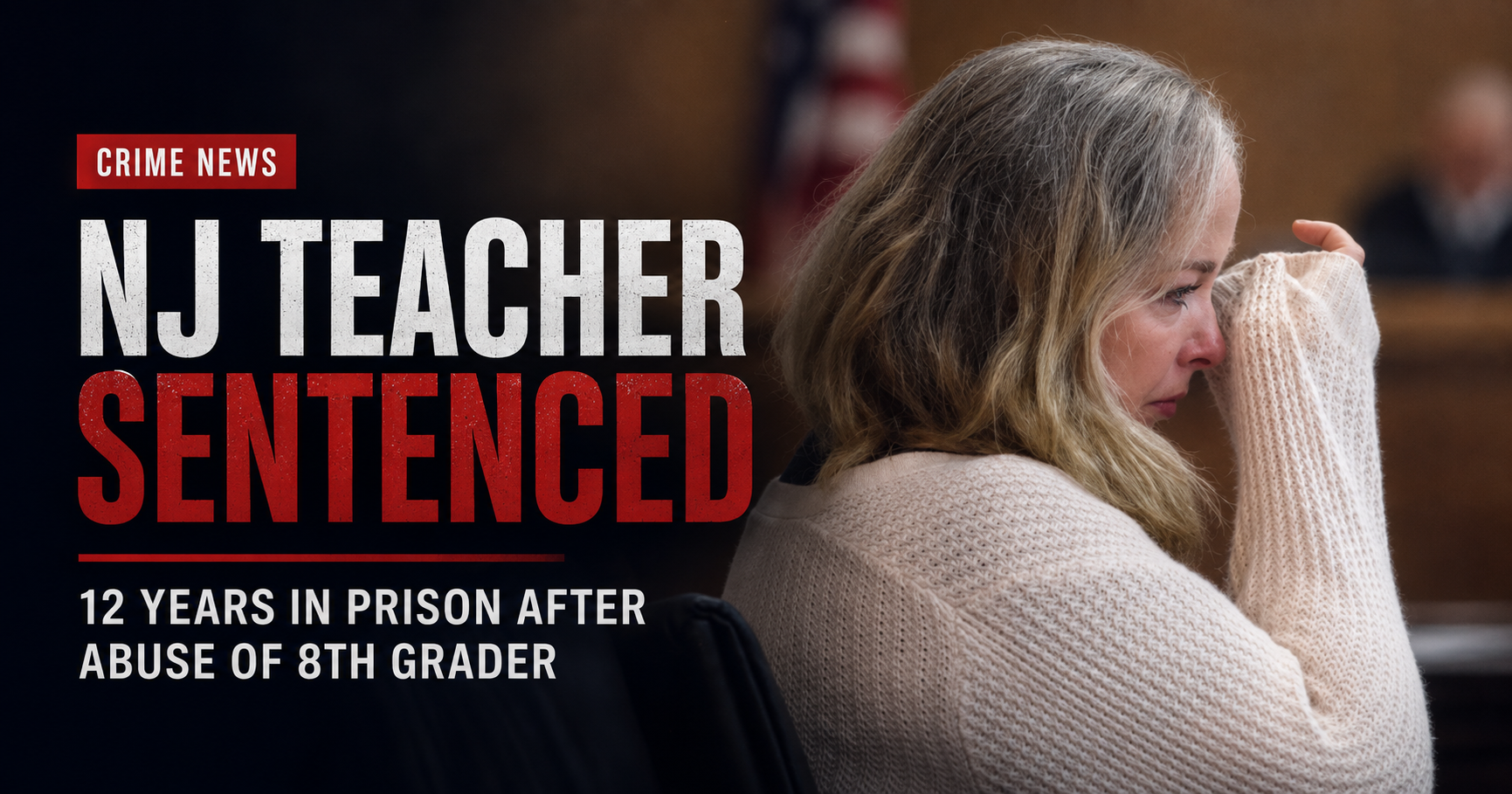
On August 28, 2026, the now-45-year-old former teacher stood before Monmouth County Superior Court Judge Jill G. O’Malley and learned what those actions would cost her.
Twelve years in New Jersey State Prison.
She must serve at least 85% of that sentence before becoming eligible for parole under New Jersey’s No Early Release Act. She will also be subject to lifetime parole supervision, must register as a sex offender under Megan’s Law, has surrendered her teaching license and is permanently barred from public employment.
But the most powerful moment of the sentencing hearing did not come from the judge.
It came from the teenager.

The Victim Called What Happened a “Nightmare”
The boy, whose identity has appropriately been protected, addressed the courtroom before Havemann-Niedrach was sentenced.
He described years of emotional consequences that followed the abuse.
School became difficult. Other students learned enough about the case to connect him to his former teacher, complicating friendships and making his high school years painful. He struggled with concentration and his grades.
For years, he said, he blamed himself.
“For two or three years, I thought it was my fault,” the teenager told the court, according to reporting from the sentencing hearing.
He described living through the aftermath as being “like a nightmare.”
Judge O’Malley noted that the teenager had contemplated suicide after revealing the abuse.
Then, after telling the court how deeply Havemann-Niedrach’s actions had affected him, the young victim said something few people in the courtroom may have expected.
He forgave her.
Havemann-Niedrach reportedly broke down crying.
“I apologize profusely for my actions,” she later told the court. “I am moved by his forgiveness.”
The judge was considerably less forgiving.
“You Are His Trauma. You Ruined Him.”
Judge O’Malley rejected any suggestion that what happened between the teacher and teenager should be characterized as a mutual romance or simply a relationship that crossed a professional boundary.
The boy was a child.
Havemann-Niedrach was his teacher.
And she was nearly three times his age.
O’Malley described the conduct as the culmination of months of grooming rather than a momentary lapse in judgment.
She told Havemann-Niedrach that the abuse was not a “trauma bond” between two equals and characterized it as a prolonged effort to seduce and abuse a boy for the adult’s own gratification.
Then she addressed the former teacher directly.
“You are his trauma. You ruined him.”
That distinction matters because cases involving female teachers and teenage boys are still sometimes described casually as “affairs,” “relationships” or teachers “having sex” with students.
Legally, that is not what happened here.
Havemann-Niedrach pleaded guilty to first-degree aggravated sexual assault.
A 15-year-old student cannot be treated as an equal romantic partner to the adult educator responsible for supervising and protecting him.
Warning Signs Were Showing Up Inside the School
The case began unraveling months before Havemann-Niedrach’s arrest.
According to prosecutors, other employees at Freehold Intermediate School began noticing that her attention toward the eighth grader appeared unusual.
She was reportedly bringing him food and eating lunch with him in a classroom on an almost daily basis.
One teacher saw Havemann-Niedrach rubbing the boy’s back and neck, touching his leg and behaving in a manner the witness described as flirtatious.
Eventually, concerns reached a vice principal.
In early June 2024, school officials contacted the Freehold Borough Police Department.
What initially looked like questionable boundaries would soon reveal something far more serious.
His Own Family Had Also Become Suspicious
Once authorities contacted the boy’s mother, investigators learned that people at home had noticed changes as well.
The teenager had become increasingly withdrawn.
His sister had reportedly seen him sitting inside Havemann-Niedrach’s car.
He was spending enormous amounts of time on his phone, including late into the night.
Investigators also learned that the teenager had told at least one friend that he was dating a teacher.
Initially, however, the boy denied that anything inappropriate was happening.
Instead, he claimed he was dating Havemann-Niedrach’s daughter.
Prosecutors later argued that this explanation was not accidental.
They said Havemann-Niedrach had used her own daughter as part of a cover story that allowed her to maintain unusually close contact with the boy while creating a seemingly innocent explanation for why he was spending so much time around her family.
That cover would collapse once police examined his phone.

Police Found More Than 25,000 Messages
The teenager’s cellphone dramatically changed the investigation.
Authorities discovered more than 25,000 messages between Havemann-Niedrach and the student.
The phone reportedly contained explicit messages, photographs and videos that prosecutors said confirmed the sexual nature of what had been taking place.
Investigators also recovered evidence showing repeated sexual contact over approximately six months, beginning in January 2024 and continuing until shortly before Havemann-Niedrach’s arrest in June.
During court proceedings, prosecutors said the encounters occurred at multiple locations, including Havemann-Niedrach’s Jackson Township home, inside a vehicle and at a hotel in East Windsor.
Cellphone location information reportedly helped corroborate the teenager’s account regarding the hotel.
Perhaps one of the most revealing details was what the boy asked police to do after investigators obtained his cellphone.
He reportedly asked them not to give it back.
According to prosecutors, the teenager believed surrendering the phone was the only way he could finally stop communicating with Havemann-Niedrach.
That detail paints a very different picture from a teenage boy enjoying an illicit romance with his teacher.
It suggests a child who no longer knew how to escape the contact.
Prosecutors Said the Grooming Started Before the Sexual Abuse
At sentencing, prosecutors and Judge O’Malley described behavior that began before the physical abuse.
Havemann-Niedrach reportedly attended the boy’s sporting events, bought him food and gifts, gave him rides and created opportunities to remain near him outside normal classroom interactions.
She allegedly became angry or threatening when he did not respond to her messages quickly enough.
The judge said Havemann-Niedrach had spent months establishing that connection before the sexual abuse began.
That pattern is consistent with what child-protection experts describe as grooming: gradually gaining a young person’s trust, creating secrecy, testing boundaries and making inappropriate behavior seem increasingly normal.
And Havemann-Niedrach held an especially significant position of authority.
She was not merely an adult who happened to know him.
She was his teacher.
She Was a Special-Education Teacher
Havemann-Niedrach began working at Freehold Intermediate School in March 2022 and served as a special-education teacher.
That detail drew particular concern during early court proceedings.
When Havemann-Niedrach appeared before Superior Court Judge Vincent N. Falcetano after her 2024 arrest, the judge reportedly noted that a special-education teacher should have an even greater understanding of appropriate boundaries with children.
Educators are trusted with access that almost no other unrelated adults receive.
They see children every day.
They understand schedules.
They learn family circumstances.
Students are conditioned to listen to them, trust them and seek their approval.
That power imbalance is precisely why laws governing sexual contact between educators and students are so strict.
Monmouth County Prosecutor Raymond S. Santiago described Havemann-Niedrach’s conduct as an extraordinary betrayal of the trust placed in teachers, saying it was difficult to imagine a more serious violation of an educator’s obligation to act in a student’s best interests.
She Was Arrested at Her Parents’ Home
Police arrested Havemann-Niedrach on June 27, 2024.
Body-camera video later obtained by Jersey Shore Online reportedly showed officers arriving at her parents’ residence.
One of the more unusual moments came when officers asked about her cellphone.
Havemann-Niedrach said it had been destroyed.
She claimed she had lost the phone earlier that day and that it had subsequently been run over.
Whatever information may have existed on her device, investigators already possessed something extremely valuable:
The teenager’s phone.
And thousands upon thousands of messages.

The Victim Suffered a Mental Health Crisis During the Investigation
As the case developed, prosecutors revealed that the teenager’s emotional condition had deteriorated severely.
During a 2024 detention hearing, Assistant Prosecutor Danielle Zanzuccki told the court that the boy experienced a mental health crisis serious enough to require hospitalization.
Prosecutors argued that the case demonstrated why describing such abuse as a consensual “relationship” minimizes what actually happens to a child caught in one.
The teenager may have told friends he was dating a teacher.
He may initially have denied the abuse.
Neither fact meant he was unharmed.
By the time he faced Havemann-Niedrach in court two years later, he described difficulty sleeping, problems concentrating and struggling socially after classmates connected him to the case.
The judge ultimately concluded the damage had been profound.
A Grand Jury Indicted Havemann-Niedrach on Seven Counts
The investigation did not initially result in a single criminal charge.
In March 2025, a Monmouth County grand jury returned a seven-count indictment.
Reports from the case indicate those counts included charges involving aggravated sexual assault, sexual assault, official misconduct, endangering the welfare of a child and manufacturing child sexual abuse material.
Havemann-Niedrach initially fought the charges.
That changed in January 2026.
On January 21, she appeared before Judge O’Malley and pleaded guilty to one count of first-degree aggravated sexual assault.
The remaining charges were dismissed as part of the negotiated plea agreement.
Prosecutors announced at the time that they would seek a 12-year state-prison term.
Seven months later, that was exactly the sentence imposed.
Twelve Years and Consequences That Continue After Prison
Havemann-Niedrach’s punishment does not end when she leaves prison.
Under the sentence imposed August 28, she must serve at least 85% of the 12-year term before parole eligibility.
That equals roughly 10 years and two months of the sentence, subject to the precise calculation of jail and sentencing credits.
Once released, she will remain under parole supervision for life.
She must register as a convicted sex offender under Megan’s Law.
Her teaching license has been surrendered.
She has forfeited the ability to hold public office or employment covered by the judgment.
And Judge O’Malley ordered Havemann-Niedrach to have no contact whatsoever with the victim or his family.
Her Husband Publicly Stood by Her
Outside the criminal case, Havemann-Niedrach’s arrest also shattered the family life displayed on her social media.
She was married to Eric Niedrach and had two daughters.
Her husband and parents appeared at some of her court proceedings, including during the earlier stages of the case.
After the arrest, Eric Niedrach launched an online fundraiser seeking help maintaining a sense of normalcy for their children, including keeping one daughter enrolled in Taekwondo.
He wrote that he continued to stand by both his wife and daughters and spoke about grace, forgiveness and his Christian faith.
The fundraiser sought $4,000 but reportedly received only $85.
It is not publicly clear whether the couple remains married.
The family’s pain is real, particularly for children who had nothing to do with their mother’s crimes.
But that pain also cannot eclipse the teenager who was placed in Havemann-Niedrach’s care and whose life was altered by her actions.

Her Social Media Presented a Very Different Woman
That contrast is part of what has made the Allison Havemann-Niedrach case attract so much attention.
Her online presence reportedly featured photographs of family vacations, her daughters, her husband and posts celebrating her Mormon faith.
Nothing about those images would suggest what prosecutors later uncovered.
But social media rarely provides a complete account of anyone’s private behavior.
Family photographs cannot tell viewers what is happening inside a classroom.
Religious posts do not guarantee ethical conduct.
A respected career does not eliminate the possibility of abuse.
And predators do not always look like the people society expects them to look like.
Sometimes they look like an involved mother.
Sometimes they are active in their community.
Sometimes they are the trusted teacher standing at the front of the classroom.
Other Teachers Noticed and That Matters
There is one important part of this case that should not be overlooked.
Adults at the school noticed something was wrong.
A teacher saw physical contact that made her uncomfortable.
Staff members questioned why Havemann-Niedrach was spending so much individual time with one student.
A vice principal escalated those concerns.
Police were contacted.
Those actions eventually exposed what investigators say had been happening for months.
It is impossible to know what might have occurred had those educators dismissed the behavior as harmless.
Their willingness to report uncomfortable observations may have prevented the abuse from continuing longer.
That is an important lesson in a case filled with terrible ones.
Warning signs do not always arrive as a child making a direct accusation.
Sometimes they are changes in behavior.
Secrecy.
Late-night messages.
An adult creating unusual access to one student.
A teacher repeatedly touching a child in ways coworkers consider inappropriate.
Individually, some of those things can have innocent explanations.
Together, they may require someone to ask more questions.
The Teenager’s Forgiveness Does Not Minimize What Happened
Perhaps the most striking moment in the entire case occurred when the teenager forgave Havemann-Niedrach.
It would be easy to misunderstand what that means.
Forgiveness does not erase abuse.
It does not convert a crime into a consensual relationship.
It does not mean the victim suddenly believes what happened was acceptable.
And it does not reduce Havemann-Niedrach’s responsibility.
Forgiveness belongs to the victim.
Punishment belongs to the court.
Judge O’Malley made that distinction unmistakably clear.
The teenager may have chosen not to carry hatred for his former teacher.
The state still sentenced her to 12 years in prison.

One Phrase From the Judge May Define the Entire Case
There will inevitably be people online who focus on Havemann-Niedrach’s appearance, marriage, religion or status as a mother.
Others will make jokes because the victim was a teenage boy and the offender was a woman.
That reaction is precisely why Judge O’Malley’s words deserve attention.
“You are his trauma.”
The victim told the court that for years he thought he was responsible.
That is one of the most damaging effects grooming can have on young victims.
An adult deliberately blurs boundaries until the child believes he participated equally in something he was never developmentally or legally equipped to navigate.
Havemann-Niedrach was the adult.
She was the educator.
She had the professional training.
She controlled the access.
And she pleaded guilty to aggravated sexual assault.
Whatever her social media profile may once have shown, that is now part of her permanent record.
The boy, meanwhile, still has the rest of his adolescence and adulthood ahead of him.
He told the court that he forgives her.
Hopefully, with time, he will also stop blaming himself.
What stands out most to you about the Allison Havemann-Niedrach case—the 25,000 messages, the warning signs other teachers noticed, the victim asking police to keep his phone so the communication would finally stop, or his decision to forgive her at sentencing? And do you think schools should have stricter rules surrounding private texting and one-on-one contact between teachers and students before behavior reaches this point? Share your thoughts in the comments.